Safe Sex Education
Safer Sex Basics
No matter what sex you are participating in, make sure you do it safe!
Protection
Condoms
Condoms protect against both STIs and pregnancy. When used consistently and properly, they can significantly reduce your chances of passing or receiving a STI.
There are two types of condoms, external condoms (male) and internal condoms (female).


Condom Tips:
- A new condom should be used every time you have sexual intercourse. From the moment the penis comes in contact with the vagina, anus, or mouth, until there is no more contact.
- Carefully unwrap the condom checking to make sure it is not damaged.
- Use water-based lubricant to prevent breakage (oil-based lubes can cause a condom to break).
- Never reuse a condom.
Common Condom Use Mistakes:
- Unrolling a condom before putting it on
- No space at the tip
- Putting on two condoms at once
- Wrong size condom
- Not removing the air from the tip
- Improper storage
- Wrong lubricant
Barrier Methods
Dental Dams
Barrier methods of protection, like a dental dam, can greatly reduce your risk of transmitting or receiving an STI through oral sex.
Dental dams can be used for oral sex performed on the vulva or anus.
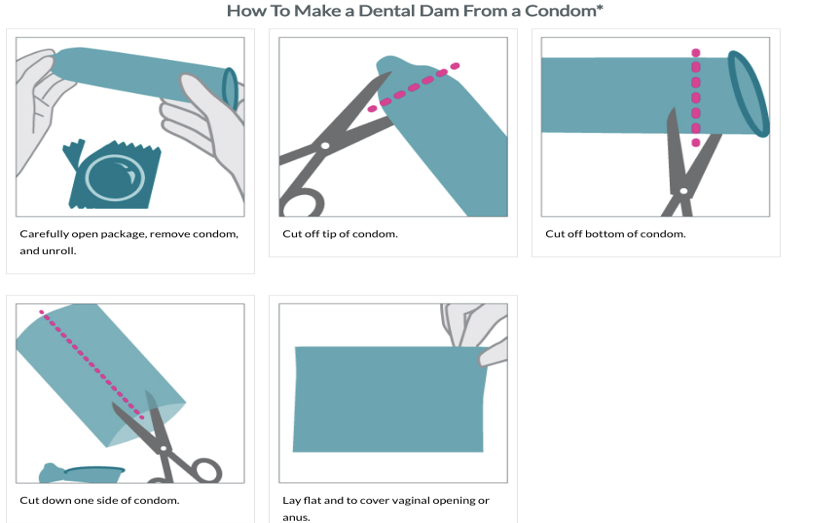
Dental dams can be made from unrolling an external condom, cutting the tip off and cutting down the side.
Know the Difference
Sexually Transmitted Infections (STIs)
Sexually Transmitted Diseases (STDs) are now called Sexually Transmitted Infections (STIs). This is because disease means being sick and having symptoms, while infection means you may not show anything but still pass the sickness onto another person.
Most STIs are caused by germs (bacteria or viruses) that are passed from one person to another during sex or intimate contact.
STIs caused by bacteria can be cured with a short course of antibiotics. If diagnosed and treated soon after infection, a bacterial STI is generally less likely to cause damage to the body.
STIs caused by viruses cannot be cured with antibiotics, but the symptoms can be managed with medication.
STI testing can help find an infection early. If you know that you have an infection, you can get treatment and prevent spreading the infection to others. Left untreated, some STIs can lead to serious problems.
Common STIs
Types & Symptoms
STIs Caused by Bacteria
Chlamydia
Signs & Symptoms
- Burning during urination
- Unusual discharge from the vagina, urethra or anus
- Itching of the groin area
If symptoms do occur, they usually take two to three weeks to appear, but they can also take up to six weeks. Chlamydia can also infect the throat.
Treatment: Can be cured with antibiotics. If left untreated, it has been known to cause infertility.
Gonorrhea
Signs & Symptoms
- Burning during urination
- Discharge from the vagina, urethra or anus
- Pain or itching of the genitals
If symptoms do occur, they often appear two to seven days after infection. Gonorrhea can also infect the throat.
Treatment: Can be cured with antibiotics. However, some strains of Gonorrhea have become resistant to some antibiotics. If left untreated, it can cause serious health problems such as infertility, pelvic inflammatory pain, and chronic pelvic pain.
Syphilis
Signs & Symptoms
- Open sores that do not hurt
- A body rash
- Feeling like you have the flu
If symptoms do occur, they can take anywhere from three to 90 days to appear.
Treatment: Can be cured by antibiotics. If untreated, it can cause damage to the heart, the brain, and other organs.
STIs Caused by Viruses
Herpes Simplex Virus (HSV)
There are two types of HSV:
- HSV-1 – “Cold Sores” – sores around the mouth (these can be hereditary)
- HSV-2 – Genital HSV – sores on the genitals
Signs & Symptoms
- Painful blisters that turn into open sores on the skin
If symptoms do occur, they can take anywhere from two to 21 days to appear. People can pass HSV even if they do not have outbreaks.
Treatment: There is no vaccine to prevent herpes and no cure, but medication can help reduce the number and severity of outbreaks.
Human Papillomavirus (HPV)
Signs & Symptoms
- Genital warts
If symptoms do occur, they can take months or years to appear.
Treatment: Most cases of HPV clear on their own within two years. There is a vaccine that protects against HPV and they are best taken before a person becomes sexually active. There is no cure for HPV but there is treatment to deal with the warts. Genital warts can be treated by freezing or putting medication on the skin. Some strains of HPV can eventually lead to cancers of the cervix, vagina, vulva, anus, penis or throat.